Co-founder · Resonate Labs
Shane Tepper
Co-founder of Resonate Labs and the author of Cited. He's known for one argument: AI visibility is decided by the questions you're measured on, and by whether an engine can read, quote, and corroborate you.
Below: who he is, the six arguments he's made on the record, and the essay to read for the problem you have today.

The short bio
He kept meeting brands that rank on Google and vanish from AI answers
Shane Tepper co-founded Resonate Labs to fix a problem you may be living with now. Your pages rank. Organic traffic slides anyway. And when a buyer asks ChatGPT, Claude, Gemini, or Perplexity who to buy from, your name isn't in the answer.
His first answer is about measurement. If your AI visibility reporting is a rankings export with a new title, he says, it's measuring the wrong thing.
The next problem sits under the score itself. A score is only as good as the questions behind it, and most tools score you against questions they guessed from the public web. Nobody on your buying committee asked them.
So he wrote the method down, edition by edition, and put a source next to every number. That's the reason to read him. You get the figure, where it came from, and where the evidence runs out.
His work is for VPs of marketing watching organic slide, demand gen leads who have to report AI visibility as a program, and SEO leads who need to know why pages that rank never get cited. It's also for founders who need their positioning set in AI answers before someone else's hardens.
“If you are not influencing the questions the engines are answering, you do not show up. The questions are the product.”
The line the Resonate Labs method is built on
The audit he cites most
2 of 150 buyer questions, from a site that ranked on Google
A B2B HRIS platform ranked on Google and still surfaced in just 2 of 150 buyer questions across four AI engines. Once its site was readable to AI crawlers and new pages shipped, it surfaced in 24 of the same 150 within six weeks: 12x more visible on a matched set.
For you, the lesson is simple. Ranking and being named are two different jobs, and a matched question set is how you tell whether your work moved the second one.
- 2/150Questions at baseline
- 24/150By week six
- 38Pages shipped in four weeks
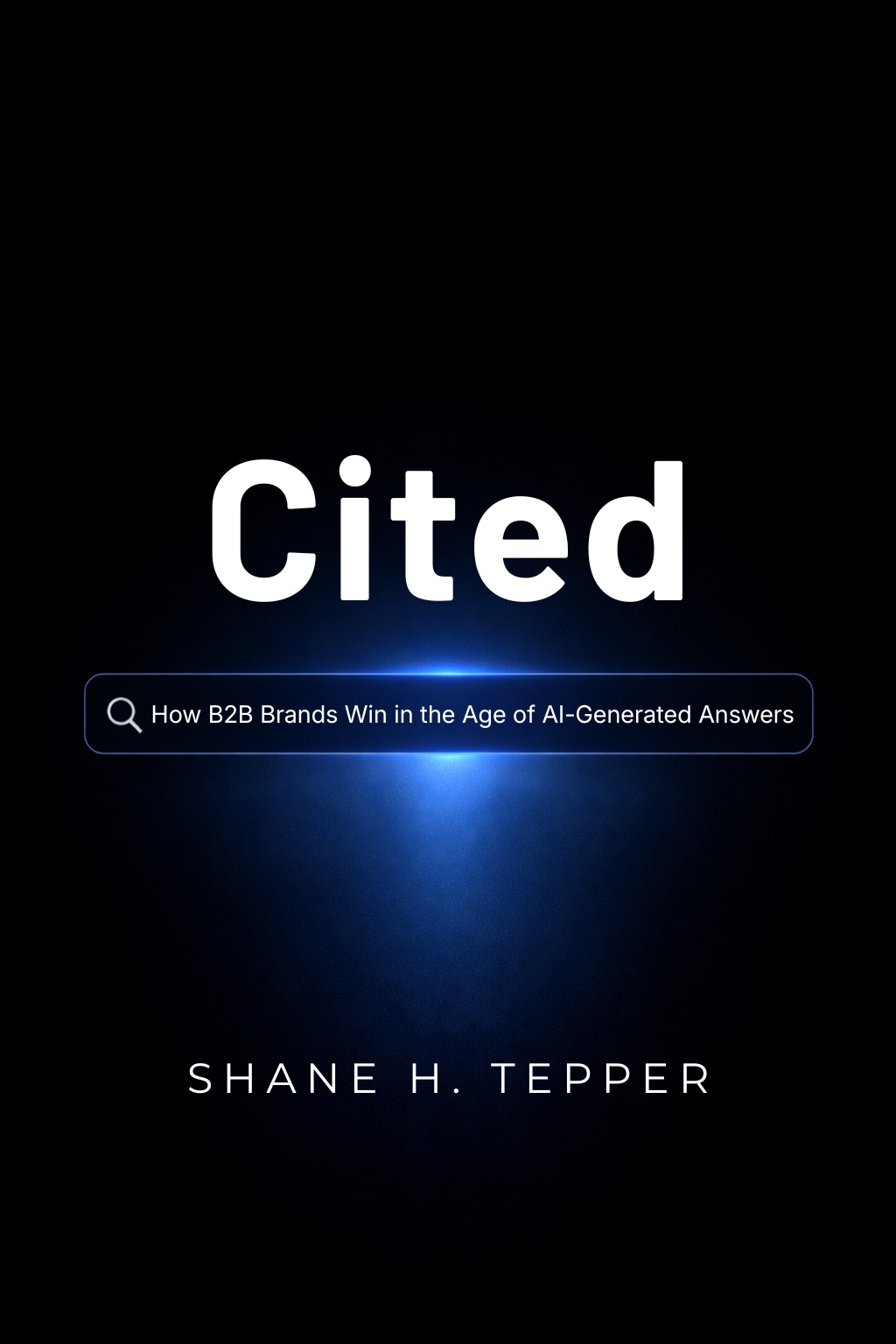
Cited, on Amazon Kindle
Credentials
What he's built and written
The résumé in brief, starting with the book every essay here builds on.
- Author of Cited: How B2B Brands Win in the Age of AI-Generated Answers
- Author of the GEO White Paper, now in its fifth edition
- Founder of Retina Media, a strategy consultancy and creative lab for AI discoverability
- Developed measurement methodology and analyzed buyer query behavior across hundreds of enterprise software brands
- More than fifteen years across film, advertising, and B2B technology
- Author of Dwelling in a Place of Yes, a book on decision-making under uncertainty
Topics and essays
Six arguments, and the essay behind each
Each card opens on a problem you might have on your desk this week. Find yours and start there.
The questions
Where your score's questions came from
Your visibility score looks healthy, and you're still losing the questions that matter.
His read: the shape of a question decides whether an AI answer recommends any vendor at all, far more than which engine you ask.
He built the Resonate Labs method around a fixed buyer-question set, published how those questions are written, and measured how question format changes recommendations.
Read “Where the questions behind an AI visibility score actually came from” →
Google vs. AI
Ranking on Google, missing from AI
You rank for the terms that matter, and AI answers still never cite you.
On the claim that GEO is just SEO: “It's half true, and the half that's wrong is the expensive half.” The expensive half is the one telling you your rankings already cover the answer layer.
He has run and published audits across competitive B2B categories, and he reads the overlap studies himself instead of citing them secondhand.
Read “Why a brand that ranks on Google can be invisible in AI answers” →
Uncredited mentions
Read by AI, never named
The engines clearly use your content, and your buyer still hears someone else's name.
His phrase for it is “reading is not crediting.” Most of what AI reads about a brand never reaches a buyer as the brand's name, so being a source and being recommended are two different wins.
His white paper makes uncredited brand appearances one of its five key findings, and he writes about the pattern for marketing and PR audiences.
Read “Reading is not crediting: the gap between what AI reads and what a buyer hears” →
Publishing speed
The lever you control most
Your fixes are briefed and approved, and they sit in a queue for months.
Once a site is readable and corroborated, he argues, how fast you publish is the variable you most control: “Citation runs on a clock measured in days while the top of search takes years, so speed becomes the lever.”
He changed the organizing thesis of his own report when the evidence moved here.
Read “AI visibility as a publishing operations discipline, not a content trick” →
Earned media
Mentions over backlinks
You've spent years building links, and AI still names a competitor.
“Getting cited by AI is not an authority game,” he says. The signal traditional SEO works hardest on is one of the weakest predictors of citation.
He wrote the three-tier citation model Resonate Labs works from, and takes it onto B2B marketing and PR podcasts, where listeners own this budget.
Measurement
What the field can't prove yet
Your board wants an AI number, and your analytics shows ordinary organic.
In his words, “Demand formation moved upstream of the click, into a layer your analytics can't see.” The influence gets credited to channels that already look familiar.
He corrected widely circulated GEO statistics his own earlier editions had repeated, and traced every figure back to its primary source.
Read “Measuring AI influence honestly, including what the field cannot prove yet” →
Want to see which questions your own buyers ask? A Resonate Labs Foundation, with the 150 buyer questions written from it, is $0: start your free Foundation.
Appearances
Where to hear him make the case
Recent podcasts, bylines, and interviews, newest first. Each one is a shorter way into the essays above.
-
Byline · Resonate Labs · Oct 6, 2026
The GEO White Paper v5.0: Why AI Visibility Is Becoming a B2B Publishing Operations DisciplineThe current edition, reorganized around publishing speed.
-
Byline · Demand Gen Report · Sep 30, 2026
Why Most Enterprise Brands Are Invisible to AIA B2BMX Insights piece for demand gen leaders.
-
Podcast · FiredUp!, Firebrand · Sep 17, 2026
How to Win More AI CitationsEpisode 144, on what earns a citation and what doesn't.
-
Interview · Market Research Journals · May 23, 2026
Zero-Click Searches: The New Benchmark in AI InfluenceWhat replaces the click as a measure of presence.
-
Interview · Streetwise Journal
Why Enterprise SEO Success Doesn't Translate to AI VisibilityThe ranking-versus-citation gap, for enterprise teams.
-
Podcast · IgnitedNeurons
The Future Belongs to People Who Do ThisA long conversation, with a full transcript.
FAQ
Questions people ask
Who is Shane Tepper?
Shane Tepper is a co-founder of Resonate Labs, which measures whether ChatGPT, Claude, Gemini, and Perplexity name a B2B brand when buyers ask who to buy from. He writes the company's method down and argues it on podcasts and in bylines for marketing and PR audiences.
What does Shane Tepper write about?
How AI engines decide which vendors to name. His essays cover where visibility questions come from, why Google rankings don't carry over, uncredited mentions, publishing speed, earned media, and how to measure AI influence without overclaiming.
What does Shane Tepper mean by "reading is not crediting"?
That an engine can read and use your page without ever saying your name to the buyer. His white paper finds most brand appearances are uncredited, and only a small fraction of the pages a model retrieves turn into a name a buyer hears.
Does Shane Tepper think GEO is just SEO?
No. He grants that the two share a foundation, since an engine can't cite a page it can't crawl. His point is that ranking and citation are decided by different processes, so strong rankings don't put you in the answer on their own.
Start here
Your rankings were never the whole story. Start with speed.
If you read one essay, make it the argument he reorganized his own report around. Then follow along on LinkedIn, where the numbers get updated as they move.
Want pages like this for your company? Start your free Foundation.